
Table of Contents
ToggleOverview
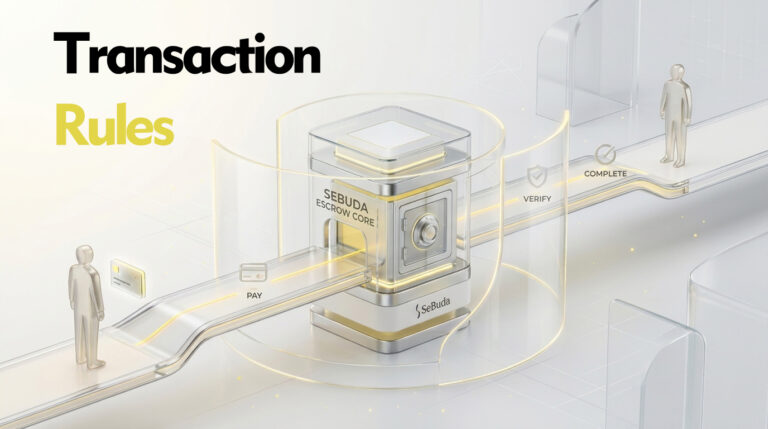
These Sebuda Transaction Rules govern the transaction process administered through Sebuda, including transaction initiation, payment, escrow administration, delivery, inspection, verification, security procedures, cancellation, refunds, Buyer inactivity, compensation, disputes, and completion.
These Rules apply to both Buyers and Sellers whenever a Transaction is initiated or conducted through Sebuda.
Sebuda operates as an independent marketplace and transaction intermediary. During an active Transaction, Sebuda may temporarily administer funds while the relevant Digital Asset is transferred, inspected, verified, completed, cancelled, refunded, or otherwise resolved under these Rules.
The purpose of the Sebuda Transaction Rules is to establish a clear, fair, transparent, and commercially reasonable process for Transactions involving eligible Digital Assets. In addition, these Rules define the procedures that Buyers, Sellers, and Sebuda must follow throughout the Transaction lifecycle.
These Rules must be read together with the applicable Buyer Rules, Seller Rules, Terms of Service, Fee Schedule, and any other policy expressly applicable to the relevant Sebuda service.
Where a rule specifically concerns the mechanics, administration, payment, transfer, inspection, security, cancellation, or resolution of a Transaction, these Transaction Rules apply.
By contrast, where a matter concerns a Seller’s responsibility for creating or maintaining a Listing, the Seller Rules apply. Likewise, where a matter concerns a Buyer’s independent obligations outside the Transaction process, the Buyer Rules apply.
Nothing in these Rules excludes, restricts, or limits any statutory right that cannot legally be excluded, restricted, or waived under Applicable Law.
1. Definitions
For the purposes of these Sebuda Transaction Rules, the following definitions apply.
1.1 Parties and Transaction Terms
Buyer means any individual or legal entity acquiring an eligible Digital Asset through a Transaction administered by Sebuda.
Seller means any individual or legal entity offering and transferring an eligible Digital Asset through Sebuda.
Digital Asset means any transferable digital property accepted by Sebuda for the relevant Transaction, including, where applicable:
-
social media accounts;
-
channels;
-
gaming accounts;
-
websites;
-
domain names;
-
applications;
-
online businesses;
-
advertising accounts;
-
digital communities;
-
SaaS accounts;
-
digital subscriptions; and
-
any other eligible digital property accepted by Sebuda.
Digital Account means any Digital Asset consisting primarily of an online account, profile, channel, page, community, or similar digital property.
Listing means information published or made available through Sebuda describing a Digital Asset and the components expressly represented as included with it.
Transaction means the process through which a Buyer proceeds with the acquisition of an eligible Digital Asset from a Seller using Sebuda’s authorized Transaction Service.
Transaction Service means the process administered by Sebuda through which funds may be temporarily held while the relevant Digital Asset is transferred, inspected, verified, completed, cancelled, refunded, or otherwise resolved.
Escrow Funds means funds received and temporarily administered by Sebuda in connection with a Transaction before their final release, refund, credit, deduction, or other lawful disposition.
1.2 Security and Transfer Terms
Admin Team means authorized Sebuda personnel responsible for Transaction administration, transfer verification, cancellation review, security assistance, evidence review, dispute handling, fraud prevention, and related Transaction procedures.
Original Email or OG Email means the first email account originally used to create or register a Digital Account where such status can reasonably be established.
Security Information means information or authentication mechanisms reasonably required to access, control, secure, recover, or transfer a Digital Asset.
Security Information may include:
-
login credentials;
-
passwords;
-
associated email access;
-
recovery email information;
-
recovery phone numbers;
-
recovery codes;
-
backup codes;
-
two-factor authentication information;
-
authenticator applications;
-
security keys;
-
active sessions;
-
administrative permissions; and
-
other authentication or recovery information.
Transaction Components means the Digital Asset together with any credentials, email access, files, domains, intellectual-property-related materials, administrative permissions, recovery information, or other components expressly represented in the Listing as being included in the Transaction.
1.3 Legal and Conduct Terms
Material Misrepresentation means materially false, misleading, inaccurate, or omitted information that could reasonably influence a Buyer’s decision to proceed with the Transaction or materially affect the Digital Asset’s ownership, security, functionality, value, transferability, or intended use.
Material Change means a modification made after delivery that may affect the Digital Asset’s condition, ownership, security, content, functionality, value, recoverability, history, evidence, or transferability.
Good Faith means acting honestly, fairly, reasonably, and cooperatively without attempting to deceive, manipulate, obstruct, abuse, or unfairly influence the Transaction process.
Applicable Law means laws, regulations, governmental requirements, court orders, regulatory obligations, and other legally binding requirements applicable to Sebuda or the relevant Transaction.
2. Scope of the Transaction Service
The Sebuda Transaction Rules apply to eligible Transactions conducted through Sebuda’s authorized Transaction Service.
Sebuda designed the Transaction Service to reduce certain risks associated with the transfer of eligible Digital Assets by administering the Transaction process and temporarily controlling the disposition of Transaction funds.
Sebuda acts as an intermediary and Transaction administrator.
Unless expressly stated otherwise, Sebuda does not become:
-
the owner of the Digital Asset;
-
the Buyer;
-
the Seller;
-
the creator of the Digital Asset;
-
the operator of the Digital Asset; or
-
a guarantor of the Digital Asset’s future performance.
Accordingly, Transaction protection applies only to Transactions conducted through Sebuda’s authorized Transaction Service.
Transactions or payments arranged outside Sebuda may fall outside the protections provided under these Rules.
In addition, the Transaction Service does not guarantee:
-
future ownership;
-
future availability;
-
future account recovery;
-
future security;
-
future monetization;
-
future revenue;
-
future audience levels;
-
future engagement;
-
future profitability;
-
future platform compliance;
-
future transferability; or
-
future decisions made by a Third-Party Platform.
2.1. Restricted Jurisdictions and Sanctions Compliance
Sebuda does not provide services to individuals or businesses located in, resident in, or operating from Cuba, Iran, North Korea, Syria, or the Crimea, Donetsk, and Luhansk regions.
Users must not use Sebuda to purchase, sell, receive payments, or otherwise facilitate transactions directly or indirectly involving these jurisdictions, products or services originating from them, or any person or entity subject to applicable sanctions.
Additional restrictions imposed by Applicable Law or Sebuda’s payment providers may also apply.
Users must provide accurate identity and location information and must not circumvent these restrictions.
Sebuda reserves the right to request supporting information and to refuse or suspend access, Listings, or Transactions where necessary to comply with these requirements.
3. Buyer Decision and Beginning a Transaction
3.1 Buyer Decision to Proceed
A Buyer may review an eligible Listing and communicate through Sebuda regarding the Digital Asset before proceeding with a Transaction.
Where applicable, the Buyer may request reasonable clarification concerning information contained in the Listing before payment.
However, a Buyer’s expression of interest, inquiry, message, or preliminary agreement does not by itself mean that a funded Transaction has begun.
Similarly, a Digital Asset should not be considered reserved, transferred, or successfully funded merely because a Buyer has expressed interest unless Sebuda confirms otherwise through the Platform.
3.2 Beginning an Active Transaction
A Transaction becomes active only after:
-
the Buyer has selected or agreed to proceed with the relevant Digital Asset;
-
the Buyer submits the required payment through an approved payment method;
-
Sebuda successfully receives or verifies the required payment;
-
any required payment, security, fraud, ownership, or compliance checks have been completed; and
-
Sebuda formally activates the Transaction.
Therefore, the Seller should begin transferring the Digital Asset only after Sebuda confirms that the Transaction may proceed.
A screenshot, blockchain transaction hash, bank receipt, payment reference, or other evidence submitted by the Buyer does not independently prove that Sebuda has received or confirmed payment.
Sebuda’s confirmation determines when the Transaction is treated as funded.
4. Pre-Funding Acknowledgment
Before completing payment, Sebuda may require the Buyer to acknowledge important information relating to the nature of the Transaction.
Such acknowledgment may include confirmation that the Buyer understands that:
-
the subject of the Transaction is digital in nature;
-
digital transfers may involve technical, security, recovery, and Third-Party Platform risks;
-
completion of delivery does not provide an unrestricted right to reverse or cancel the Transaction;
-
any cancellation request must comply with these Transaction Rules;
-
a cancellation request concerning the condition of the Digital Asset should be submitted before the Buyer makes a Material Change;
-
after control has been transferred and the Transaction has been completed, responsibility for maintaining the Buyer’s access and security generally transfers to the Buyer, subject to any unresolved dispute or applicable Seller cooperation obligation; and
-
Sebuda’s Transaction Service does not guarantee future actions or decisions of any Third-Party Platform.
Accordingly, the purpose of this acknowledgment is to ensure that the Buyer understands the basic characteristics and risks of a digital Transaction before funding it.
5. Payment Methods and Transaction Funding
5.1 Approved Payment Methods
All Transaction payments must be made using payment methods approved and made available by Sebuda.
Approved payment methods may include:
-
supported cryptocurrencies or stablecoins;
-
approved bank transfers, where available; and
-
other payment methods expressly introduced or authorized by Sebuda.
Sebuda may add, suspend, modify, restrict, or discontinue payment methods where reasonably necessary because of technical, security, legal, compliance, operational, or payment-provider requirements.
5.2 Cryptocurrency Payments
Where cryptocurrency payments are accepted, the Buyer is responsible for following Sebuda’s payment instructions accurately.
Before initiating payment, the Buyer must verify:
-
the supported cryptocurrency or token;
-
the supported blockchain network;
-
the required payment amount;
-
the destination wallet address;
-
any required memo, tag, or reference;
-
applicable blockchain or network fees; and
-
other payment instructions provided by Sebuda.
A transfer made through:
-
an incorrect blockchain;
-
an unsupported cryptocurrency;
-
an inaccurate wallet address;
-
an incompatible wallet;
-
an incorrect memo or tag;
-
an incorrect payment amount; or
-
another incompatible payment method
may be permanently unrecoverable.
Moreover, blockchain confirmation times, gas fees, network congestion, validator activity, blockchain outages, and similar external events remain outside Sebuda’s direct control.
5.3 Bank Transfers
Where bank transfer is available, Buyers must follow the payment instructions issued by Sebuda.
Sebuda may request information reasonably necessary to:
-
identify the transfer;
-
confirm the payer;
-
verify receipt;
-
prevent fraud;
-
verify source of funds where legally required; or
-
satisfy applicable legal or regulatory obligations.
As a result, Sebuda may delay, reject, return where reasonably possible, or hold a transfer pending further verification if the transfer:
-
cannot reasonably be identified;
-
contains inaccurate information;
-
originates from an unauthorized source; or
-
otherwise fails to comply with payment instructions.
5.4 Payment Confirmation
Sebuda considers a Transaction funded only after it has successfully received, verified, and confirmed the required payment.
However, confirmation may be delayed because of:
-
blockchain confirmation requirements;
-
banking procedures;
-
payment-provider review;
-
technical interruptions;
-
fraud-prevention checks;
-
compliance review;
-
incomplete payment information;
-
currency conversion; or
-
circumstances outside Sebuda’s reasonable control.
6. Escrow Administration
Once Sebuda funds and activates a Transaction, the relevant funds remain under Sebuda’s administration until the Transaction is:
-
successfully completed;
-
cancelled;
-
refunded;
-
disputed;
-
otherwise resolved; or
-
dealt with as required by Applicable Law.
Neither the Buyer nor the Seller may independently require release or return of Escrow Funds contrary to the applicable Transaction procedure.
Where reasonably necessary, Sebuda may temporarily retain Escrow Funds to:
-
verify delivery;
-
verify ownership;
-
verify Original Email transfer;
-
investigate a dispute;
-
investigate suspected fraud;
-
investigate an account recovery event;
-
investigate a security issue;
-
verify payment;
-
obtain required evidence; or
-
comply with Applicable Law.
7. Digital Asset Delivery
After Sebuda confirms that the Transaction may proceed, the Seller must provide the information and components reasonably necessary to give the Buyer the level of access, control, and ownership expressly represented in the Listing and agreed as part of the Transaction.
Depending on the Digital Asset, delivery may include:
-
login credentials;
-
passwords;
-
associated email access;
-
Original Email where expressly included;
-
recovery information;
-
recovery email information;
-
recovery codes;
-
backup codes;
-
authenticator information;
-
two-factor authentication information;
-
administrative permissions;
-
ownership-transfer permissions;
-
associated domain access where expressly included;
-
files or digital materials expressly included;
-
other Transaction Components expressly included in the Listing; and
-
any additional item reasonably necessary to deliver the level of control represented in the Transaction.
In addition, the Seller must not intentionally retain undisclosed access or recovery mechanisms that would enable unauthorized future control of the transferred Digital Asset.
After obtaining access, the Buyer must promptly review the transferred information.
8. Components Included in the Transaction
A Seller must deliver the components expressly represented as included in the Listing or otherwise expressly agreed through Sebuda as part of the Transaction.
Because one Transaction may differ from another, Sebuda does not automatically assume that every Digital Asset includes every potentially associated file, email address, domain, intellectual property item, business record, or Third-Party service.
Where expressly included in the Listing, Transaction Components may include:
-
social media usernames or handles;
-
associated email accounts;
-
Original Email;
-
login credentials;
-
recovery information;
-
administrative rights;
-
associated domains;
-
transferable files;
-
logos or media files;
-
business materials;
-
transferable intellectual-property-related materials;
-
transferable rights or permissions;
-
documentation expressly included in the Listing; and
-
other expressly disclosed components.
The Seller must provide all Transaction Components represented as included.
Furthermore, the Seller must not substitute, remove, withhold, or materially alter an included Transaction Component without the Buyer’s knowledge and Sebuda’s approval where such approval is reasonably required.
If a component is not expressly represented as included, the Buyer should not assume that it automatically forms part of the Transaction.
Therefore, the parties should clarify any uncertainty regarding an important Transaction Component before payment whenever reasonably possible.
A Seller’s failure to deliver a component that was materially represented as included may constitute Material Misrepresentation and may result in Transaction review under these Rules.
9. Original Email Transfer
Where Original Email is expressly included in the Transaction, it forms a material part of the Transaction Components.
The Seller must transfer the Original Email and provide the Buyer with the level of control represented in the Listing.
Before completion of the Transaction, where technically applicable, the Seller must:
-
provide Original Email login information;
-
remove personal recovery methods controlled by the Seller;
-
remove Seller-controlled backup codes;
-
disable or remove Seller-controlled two-factor authentication;
-
remove Seller-controlled authentication applications or devices;
-
remove other Seller-controlled recovery mechanisms; and
-
transfer the Original Email in a condition that enables the Buyer to establish control.
Accordingly, the Seller must not represent Original Email as included unless the Seller is technically and lawfully able to transfer it.
9.1 Failure to Deliver Original Email
Where the Seller represents that Original Email is included but cannot deliver it as represented, Sebuda may impose an administrative fee of up to USD $5 for materially inaccurate Listing or Transaction information.
If Sebuda cancels the Transaction because the Seller is unable or unwilling to provide Original Email that was expressly represented as included, Sebuda may impose an administrative cancellation fee of USD $10 on the Seller.
Where permitted by Applicable Law, Sebuda may deduct such amounts from the Seller’s available balance, proceeds, or other amounts payable through Sebuda.
These administrative fees do not prevent Sebuda from taking additional appropriate action under the Seller Rules or other applicable policies.
10. Buyer Inspection Period
Under the Sebuda Transaction Rules, the Buyer must inspect the Digital Asset before making any Material Change.
Immediately after receiving access, the Buyer must determine whether the delivered Digital Asset materially corresponds to the Listing.
Unless Sebuda provides a different period for a specific Transaction, the Buyer will normally have one (1) hour from receiving functional access to inspect the Digital Asset and notify Sebuda of a material issue or intention not to proceed.
During this inspection period, the Buyer may review the Digital Asset but must not make Material Changes.
The purpose of the inspection period is to allow the Buyer to check the Digital Asset in substantially the same condition in which it was delivered.
10.1 What the Buyer Should Inspect
Inspection should include, where applicable:
-
login functionality;
-
access credentials;
-
account control;
-
Original Email status;
-
associated email access;
-
recovery information;
-
authentication information;
-
account restrictions;
-
warnings or strikes;
-
monetization status;
-
business or advertising settings;
-
security configuration;
-
audience or activity information; and
-
other material characteristics represented in the Listing.
During inspection, the Buyer should not delete, archive, hide, publish, or modify Content.
If the Buyer identifies a potentially material issue, the Buyer must contact the Sebuda Admin Team through Sebuda’s official website communication system before modifying the Digital Asset.
11. No Modification Before Cancellation
This rule is a fundamental condition of Sebuda’s cancellation procedure.
Where a Buyer believes that the Digital Asset materially differs from the Listing or wishes to request cancellation for another legitimate reason, the Buyer must contact the Sebuda Admin Team before making a Material Change.
A message sent only to the Seller does not constitute a formal cancellation request.
Furthermore, the Buyer must not modify the Digital Asset first and then seek to return it in a materially changed condition.
11.1 Examples of Material Changes
Material Changes include, without limitation:
-
changing passwords;
-
changing usernames;
-
changing email addresses;
-
changing recovery email addresses;
-
changing recovery phone numbers;
-
enabling, disabling, or modifying two-factor authentication;
-
changing security settings;
-
connecting or disconnecting applications;
-
changing administrative permissions;
-
adding or removing users;
-
modifying payment settings;
-
modifying business settings;
-
modifying advertising settings;
-
publishing Content;
-
deleting Content;
-
editing Content;
-
archiving or restoring Content;
-
changing posts, videos, images, stories, reels, comments, messages, descriptions, links, or media;
-
modifying analytics or insights;
-
changing monetization settings;
-
starting advertisements or campaigns;
-
transferring associated assets;
-
transferring control to another person; or
-
making another modification affecting the Digital Asset’s security, ownership, content, condition, functionality, history, value, or transferability.
Maintaining the Digital Asset in its original delivered condition helps Sebuda preserve evidence and investigate cancellation requests fairly.
12. Security During the Transfer Process
Buyers and Sellers must avoid unnecessary actions during an active Transaction that could create avoidable security risks or trigger automated restrictions imposed by the relevant Third-Party Platform.
Depending on the circumstances, the parties should avoid:
-
excessive login attempts;
-
repeated password resets;
-
unnecessary account recovery attempts;
-
repeated device changes;
-
repeated IP or location changes over a short period;
-
excessive requests for verification codes;
-
unnecessary changes to security settings; or
-
other actions reasonably likely to trigger automated security systems.
Where uncertainty exists concerning the safest transfer procedure, the parties should contact Sebuda before taking additional security actions.
In addition, Buyers should review Sebuda’s applicable account-security guidance before making significant security changes to a transferred Digital Account.
13. Security Verification Codes
Verification codes, authentication links, login confirmations, password-reset codes, and similar Security Information should be requested only when reasonably necessary.
Both parties must handle such information securely.
In particular, neither party may disclose verification codes to unauthorized persons.
Repeated or unnecessary requests may trigger restrictions or security measures controlled by the relevant Third-Party Platform.
Therefore, where login or verification problems occur, the affected party should notify Sebuda before repeatedly requesting additional codes or taking further actions that may affect the Digital Asset.
14. Transaction Communications and Evidence
All material Transaction communications should be conducted through Sebuda’s official communication system whenever reasonably possible.
This includes communications relating to:
-
payment;
-
delivery;
-
credentials;
-
Transaction Components;
-
Original Email;
-
verification;
-
security;
-
inspection issues;
-
cancellation;
-
disputes; and
-
Transaction completion.
Sebuda cannot independently guarantee the authenticity, timing, completeness, or context of communications occurring through Telegram, WhatsApp, Discord, Skype, external email, social media, telephone, or other unofficial channels.
Therefore, Sebuda may give greater evidential weight to:
-
Platform communications;
-
Transaction records;
-
timestamps;
-
uploaded files;
-
screenshots;
-
screen recordings;
-
payment records;
-
technical records; and
-
other information preserved through Sebuda.
Nevertheless, Sebuda may consider reliable external evidence where reasonably necessary to reach a fair outcome.
15. Transaction Verification
Sebuda may conduct reasonable verification before determining that a Transaction has been successfully completed.
Verification may include confirming:
-
that the Buyer received functional access;
-
that represented Transaction Components were delivered;
-
that Original Email was transferred where included;
-
that required Security Information was provided;
-
that any applicable ownership-transfer procedures were completed;
-
that no unresolved Material Misrepresentation has been reported;
-
that no active cancellation request remains;
-
that no active dispute remains unresolved; and
-
that there is no reasonable basis for continuing to hold Transaction Funds.
Sebuda’s verification confirms only that the applicable Transaction requirements were reasonably satisfied based on information available at the time of review.
Accordingly, verification does not constitute a continuing guarantee concerning the future condition or performance of the Digital Asset.
16. Transaction Completion
Sebuda will normally consider a Transaction complete once it reasonably determines that:
-
the Buyer received the agreed level of access or control;
-
the required Transaction Components were delivered;
-
Original Email requirements were completed where applicable;
-
the applicable inspection or verification procedure has concluded;
-
no unresolved cancellation request remains;
-
no active Transaction dispute remains; and
-
there is no reasonable basis for continuing to retain the Escrow Funds.
Transaction completion confirms only that Sebuda’s Transaction process has concluded.
Therefore, completion does not constitute a continuing guarantee concerning:
-
future ownership;
-
future account recovery;
-
future security;
-
future availability;
-
future monetization;
-
future revenue;
-
future audience levels;
-
future engagement;
-
future profitability;
-
future transferability; or
-
future actions of a Third-Party Platform.
17. Release of Funds
Following successful completion of a Transaction, Sebuda will ordinarily begin releasing the relevant proceeds to the Seller within approximately forty-eight (48) hours.
However, payment release may take longer where reasonably necessary because of:
-
fraud prevention;
-
ownership verification;
-
Original Email verification;
-
security review;
-
dispute investigation;
-
payment confirmation;
-
technical verification;
-
blockchain processing;
-
payment-provider processing;
-
compliance review;
-
legal obligations; or
-
another circumstance reasonably requiring additional review.
Any processing timeframe is an estimate and does not constitute an absolute contractual guarantee.
Nevertheless, Sebuda will use commercially reasonable efforts to avoid unnecessary delay.
18. Transaction Cancellation
Under the Sebuda Transaction Rules, Sebuda reviews cancellation requests according to the circumstances of the individual Transaction.
Digital Assets differ significantly in ownership structure, security mechanisms, recovery procedures, technical characteristics, and Third-Party Platform requirements.
For this reason, Sebuda does not apply one automatic cancellation rule to every Transaction.
Instead, Sebuda may review cancellation requests individually.
18.1 Factors Considered During Cancellation Review
Sebuda may consider:
-
Listing information;
-
represented Transaction Components;
-
condition of the Digital Asset;
-
communications;
-
payment records;
-
Transaction records;
-
available evidence;
-
actions of the Buyer;
-
actions of the Seller;
-
security modifications;
-
Material Misrepresentation;
-
ownership issues;
-
Original Email issues;
-
account recovery events;
-
Third-Party Platform actions;
-
Applicable Law; and
-
other circumstances reasonably relevant to the Transaction.
Nothing in these Rules guarantees approval of a cancellation request.
18.2 How to Request Cancellation
A Buyer requesting cancellation must contact the Sebuda Admin Team through Sebuda’s official website chat or communication system.
A message sent only to the Seller does not constitute a formal cancellation request.
Sebuda considers a cancellation request submitted when the Buyer communicates it to the Admin Team through Sebuda’s official system.
Where cancellation relates to the condition, delivery, or characteristics of the Digital Asset, the Buyer should submit the request before making any Material Change.
19. Cancellation After Account Modification
Once the Buyer materially modifies the Digital Asset, cancellation will normally no longer be available.
This is because such modifications may make it difficult or impossible to determine:
-
the Digital Asset’s original condition;
-
whether an alleged issue existed before delivery;
-
whether the Buyer caused or contributed to the issue;
-
whether the Digital Asset can safely be returned;
-
whether original security can be restored;
-
whether Transaction evidence remains reliable; or
-
whether the original value or marketability can be restored.
Accordingly, Sebuda will normally not accept cancellation or refund requests submitted after Material Changes.
19.1 Exceptional Circumstances
Nevertheless, Sebuda may conduct additional review where sufficient evidence indicates circumstances involving:
-
proven or suspected fraud;
-
Material Misrepresentation;
-
unauthorized ownership;
-
significant security compromise;
-
unauthorized account recovery;
-
legal or regulatory requirements; or
-
another exceptional circumstance Sebuda reasonably determines requires review.
The existence of an exceptional circumstance does not automatically require Sebuda to approve cancellation.
Instead, the outcome will depend on the available evidence and the individual circumstances of the Transaction.
20. Restoration and Compensation Following Cancellation
Where Sebuda approves cancellation after the Buyer has changed Security Information or other aspects of the Digital Asset, Sebuda may require the Buyer, where reasonably possible and safe, to restore the Digital Asset substantially to the condition in which it was received.
Restoration may include:
-
credentials;
-
recovery information;
-
security settings;
-
account permissions;
-
Content;
-
connected services;
-
administrative settings; or
-
other relevant Transaction Components.
Where complete restoration is impossible, unsafe, or commercially unreasonable, Sebuda may determine another proportionate resolution.
Furthermore, where the Buyer’s actions materially reduced the value, functionality, security, transferability, or marketability of the Digital Asset, Sebuda may, where permitted by Applicable Law, determine that reasonable compensation should be paid to the Seller or deducted from an amount otherwise refundable to the Buyer.
20.1 Factors Used to Determine Compensation
Sebuda may consider:
-
the nature of the changes;
-
available evidence;
-
measurable loss;
-
restoration costs;
-
conduct of the parties;
-
remaining value of the Digital Asset; and
-
other relevant circumstances.
Any compensation under this Section should remain reasonable and proportionate and is not intended to constitute punitive damages.
21. Buyer Inactivity
A Buyer who has funded an active Transaction is expected to participate reasonably in the Transaction and respond to necessary communications.
Buyer Inactivity may include:
-
failing to respond through Sebuda;
-
failing to complete a required Transaction step;
-
failing to inspect the Digital Asset;
-
failing to provide reasonably requested information;
-
failing to cooperate with delivery;
-
failing to cooperate with verification;
-
failing to cooperate with cancellation or dispute procedures; or
-
remaining absent in a manner that prevents completion of the Transaction.
21.1 Initial Inactivity Notice
Where the Buyer becomes inactive, Sebuda may pause the Transaction and issue a formal inactivity notice through:
-
the Sebuda Platform;
-
the Buyer’s registered email address; or
-
another official Sebuda communication method.
The inactivity period will normally begin on the date the first formal inactivity notice is issued.
21.2 Ten-Day Response Period
Following the formal inactivity notice, Sebuda will normally allow the Buyer up to ten (10) calendar days to return and complete the required Transaction steps.
During this period:
-
the Transaction may remain paused;
-
Escrow Funds may remain under Sebuda’s control;
-
the Seller may be instructed to preserve the Digital Asset;
-
the Digital Asset should not be transferred to another Buyer unless Sebuda authorizes otherwise; and
-
Sebuda may request additional information from either party.
If the Buyer returns within this period, Sebuda may resume the Transaction or determine another appropriate resolution based on the circumstances.
21.3 Cancellation Due to Buyer Inactivity
If the Buyer remains inactive for more than ten (10) calendar days following the formal inactivity notice, Sebuda may cancel the Transaction.
Before doing so, Sebuda may consider:
-
whether reasonable notice was provided;
-
whether the Buyer had a reasonable opportunity to respond;
-
whether technical or security problems prevented access;
-
whether the Seller fulfilled the required Transaction steps;
-
whether the Digital Asset can safely be returned to the Seller; and
-
other relevant evidence.
Cancellation due to Buyer Inactivity does not transfer ownership or control of the Digital Asset to the Buyer.
22. Seller Compensation for Buyer Inactivity
Where a Transaction is cancelled primarily because of Buyer Inactivity, Sebuda may, at its reasonable discretion and where permitted by Applicable Law, award the Seller compensation of up to USD $10.
The compensation is intended to reimburse the Seller for reasonable:
-
time;
-
preparation;
-
inconvenience;
-
reservation of the Digital Asset; and
-
opportunity cost associated with the cancelled Transaction.
Sebuda may award compensation only where:
-
the Buyer had prior notice of this policy;
-
the Seller completed the required Transaction steps;
-
the Seller reasonably cooperated with Sebuda;
-
Buyer Inactivity was the primary cause of cancellation;
-
the deduction is permitted by Applicable Law; and
-
the amount is reasonable and proportionate.
Where permitted, Sebuda may deduct the compensation from the Buyer’s remaining Escrow Funds or available balance before refunding, crediting, or otherwise dealing with the remaining amount.
This compensation is intended as reasonable reimbursement and does not constitute a contractual penalty or punitive damages.
22.1 Promotional Placement Following Inactivity Cancellation
Where a Transaction is cancelled after the applicable ten-day Buyer inactivity period and the Seller has fulfilled the applicable Transaction obligations, Sebuda may also provide the affected Digital Asset with up to ten (10) days of priority or pinned placement on the Sebuda marketplace, subject to technical availability and applicable Platform procedures.
The purpose of such placement is to help restore the Seller’s opportunity to make the Digital Asset available to other potential Buyers after it remained reserved during the inactive Transaction.
However, this promotional placement has no cash value, is not transferable, and does not guarantee visibility, inquiries, or completion of another Transaction.
23. Remaining Escrow Balance and Prolonged Buyer Inactivity
Following cancellation caused by Buyer Inactivity and after any lawful compensation or Transaction-related deductions, the remaining Escrow balance may remain available in the Buyer’s Sebuda account for up to thirty (30) calendar days.
During this period, and subject to any required verification, the Buyer may return and use an available balance toward another eligible Transaction.
However, the cancelled Transaction will not automatically be reinstated.
Sebuda is also not required to reserve the previously cancelled Digital Asset for the Buyer.
23.1 Inactivity Beyond Thirty Days
Where the Buyer remains inactive for more than thirty (30) calendar days following cancellation, Sebuda may close or administratively resolve the abandoned Transaction.
Where clearly disclosed in advance and permitted by Applicable Law, Sebuda may deduct from the remaining balance:
-
applicable Sebuda commission;
-
unpaid payment-processing or Transaction costs;
-
Seller compensation lawfully awarded under these Rules; and
-
an administrative inactivity fee of up to USD $50, representing reasonable operational, administrative, compliance, monitoring, fraud-prevention, customer-support, and account-management costs associated with administering an abandoned Transaction.
The administrative inactivity fee is intended to recover reasonable costs and does not constitute a punitive charge.
Sebuda will handle any remaining balance in accordance with Applicable Law and its applicable balance procedures.
Nothing in this Section limits any mandatory statutory rights available to a Consumer.
24. Transaction Disputes
Sebuda reviews Transaction disputes in accordance with the Sebuda Transaction Rules and the available Transaction evidence.
Where a Transaction dispute arises, both Buyer and Seller must cooperate in Good Faith and provide reasonably requested information.
24.1 Information Required for a Dispute
A party raising a dispute should identify:
-
the relevant Transaction;
-
the nature of the problem;
-
the outcome requested;
-
relevant Platform communications;
-
screenshots or screen recordings;
-
relevant payment evidence;
-
Digital Asset information;
-
relevant Transaction Components;
-
relevant Security Information; and
-
any modifications made after delivery.
24.2 Evidence Sebuda May Consider
Sebuda may consider:
-
Platform communications;
-
payment records;
-
Transaction records;
-
timestamps;
-
technical records;
-
security logs;
-
login history;
-
screenshots;
-
screen recordings;
-
blockchain records;
-
ownership evidence;
-
Original Email evidence;
-
delivery evidence;
-
condition of the Digital Asset;
-
represented Transaction Components;
-
conduct of Buyer and Seller; and
-
other reasonably reliable evidence.
24.3 Actions Sebuda May Request During a Dispute
Where necessary, Sebuda may request that either party:
-
preserve the Digital Asset in its current condition;
-
stop making changes;
-
provide additional evidence;
-
avoid unnecessary logins;
-
avoid repeated verification requests;
-
provide transfer-related information;
-
assist with restoration;
-
return access where cancellation is approved; or
-
take another reasonable action necessary to protect security or preserve evidence.
24.4 Possible Internal Resolutions
Depending on the circumstances, an internal Transaction resolution may include:
-
completion of the Transaction;
-
cancellation;
-
return of the Digital Asset;
-
release of funds;
-
refund;
-
partial reimbursement;
-
reasonable compensation;
-
restoration of security settings;
-
additional cooperation;
-
additional verification; or
-
another proportionate resolution permitted by Applicable Law.
25. Fraud and Transaction Abuse
Fraud, deception, manipulation, and abuse of Sebuda’s Transaction Service are prohibited.
Prohibited Transaction conduct includes:
-
providing materially false Transaction information;
-
submitting manipulated or falsified evidence;
-
falsifying payment information;
-
using stolen or unauthorized payment methods;
-
materially misrepresenting ownership;
-
manipulating Digital Asset information to create a false dispute;
-
intentionally damaging or altering a Digital Asset before seeking cancellation;
-
unauthorized account recovery after completion;
-
abusing cancellation procedures;
-
abusing dispute procedures;
-
knowingly filing an unjustified chargeback after receiving and retaining the Digital Asset;
-
impersonating another Transaction participant;
-
intentionally obstructing Transaction completion;
-
manipulating evidence; or
-
attempting to unfairly influence Sebuda’s Transaction decision.
Where Sebuda reasonably suspects fraud or abuse, it may pause or investigate the Transaction.
In addition, Sebuda may take further action under other applicable Sebuda policies or Applicable Law.
26. Off-Platform Transactions
Transactions initiated through Sebuda must be completed through Sebuda’s authorized Transaction Service unless Sebuda expressly authorizes otherwise.
Neither Buyer nor Seller may attempt to bypass Sebuda by:
-
requesting direct cryptocurrency payment;
-
requesting direct bank payment;
-
providing external payment links;
-
directing the other party to another marketplace;
-
offering financial incentives to avoid Sebuda;
-
transferring the Digital Asset privately to bypass the Transaction process;
-
intentionally circumventing Sebuda’s applicable fees; or
-
otherwise arranging substantially the same Transaction outside Sebuda.
As a result, payments or transfers completed outside Sebuda’s authorized Transaction Service may not qualify for:
-
escrow protection;
-
Transaction protection;
-
cancellation review;
-
refund administration;
-
dispute assistance; or
-
other Transaction protections provided by Sebuda.
Where reasonably necessary, Sebuda may cancel or suspend an active Transaction following an attempt to circumvent the Transaction Service.
27. Third-Party Platform Events
Digital Assets may depend on services operated independently by Third-Party Platforms.
Such platforms may independently:
-
suspend an account;
-
restrict access;
-
require verification;
-
disable features;
-
change security procedures;
-
change recovery procedures;
-
modify monetization;
-
change usernames or identifiers;
-
change algorithms;
-
amend policies;
-
recover or reclaim an account;
-
terminate services; or
-
otherwise affect a Digital Asset.
Where such an event occurs during an active Transaction, Sebuda may investigate its relevance to:
-
delivery;
-
ownership;
-
security;
-
cancellation;
-
Transaction completion; or
-
a pending dispute.
A Third-Party Platform action does not automatically establish fault by either Buyer or Seller.
Therefore, Sebuda may consider timing, causation, available evidence, party conduct, and other relevant circumstances.
28. Sebuda’s Transaction Administration Authority
For the purpose of administering an active Transaction, Sebuda may reasonably:
-
activate a Transaction;
-
pause a Transaction;
-
extend a verification period;
-
delay release of Escrow Funds;
-
request additional information;
-
request payment evidence;
-
request ownership evidence;
-
request delivery evidence;
-
request security information relevant to the Transaction;
-
investigate Material Misrepresentation;
-
investigate suspected fraud;
-
investigate account recovery;
-
supervise restoration;
-
review a cancellation request;
-
approve or reject cancellation;
-
determine an appropriate refund;
-
determine reasonable compensation;
-
cancel a Transaction;
-
complete a Transaction; or
-
take another proportionate step reasonably necessary to administer the Transaction.
28.1 Extension of Transaction or Verification Periods
Sebuda may extend Transaction or verification periods where reasonably necessary because of:
-
fraud prevention;
-
ownership verification;
-
security concerns;
-
account recovery investigations;
-
technical problems;
-
Transaction disputes;
-
payment delays;
-
Third-Party Platform events;
-
compliance requirements; or
-
legal obligations.
Any administrative measure should remain proportionate to the circumstances and reasonably connected to administration of the relevant Transaction.
29. Final Transaction Determination
Any final internal Transaction determination under the Sebuda Transaction Rules will be based on the information and evidence reasonably available to Sebuda.
Sebuda may consider:
-
Platform records;
-
Transaction records;
-
communications;
-
payment records;
-
timestamps;
-
technical information;
-
security information;
-
Listing information;
-
represented Transaction Components;
-
delivery evidence;
-
ownership information;
-
Original Email information;
-
condition of the Digital Asset;
-
actions taken by Buyer and Seller;
-
Third-Party Platform events; and
-
other reliable evidence relevant to the Transaction.
Following its review, Sebuda will communicate its internal Transaction determination and, where appropriate and legally permitted, the principal reasons relevant to that outcome.
Sebuda’s determination constitutes the Platform’s final internal administrative decision concerning the Transaction Service.
However, nothing in this Section prevents a Buyer or Seller from exercising a statutory or other legal right that cannot lawfully be excluded, restricted, or waived under Applicable Law.
Important Transaction Principles
The following principles summarize several of the most important requirements established throughout the Sebuda Transaction Rules.
1. A Transaction Is Not Active Merely Because a Buyer Expresses Interest
Payment must be received or verified, and Sebuda must activate the Transaction.
2. The Seller Must Deliver What Was Represented as Included
All material Transaction Components expressly included in the Listing must be delivered as represented.
3. The Buyer Must Inspect Before Changing
The Buyer should use the applicable inspection period to review the Digital Asset without making Material Changes.
4. Cancellation Must Be Requested Before Modification
Where the Buyer wants to request cancellation, the Buyer should contact the Sebuda Admin Team before changing passwords, security settings, Content, recovery information, or other material elements.
5. Original Email Must Be Delivered Where Promised
Where Original Email was expressly included, failure to provide it may result in Transaction cancellation and applicable administrative fees.
6. Transaction Communications Should Remain on Sebuda
Platform records provide the strongest basis for verification and dispute review.
7. Buyer Inactivity May Result in Cancellation
Following the applicable inactivity notice and ten-day response period, Sebuda may cancel an abandoned Transaction and apply the remedies described in these Rules.
8. Transaction Completion Is Not a Future-Performance Guarantee
Sebuda administers the transfer process but cannot guarantee future security, monetization, performance, audience levels, recoverability, or Third-Party Platform decisions.
9. Individual Circumstances Matter
Because of the technical nature of Digital Assets, cancellation, disputes, restoration, and other Transaction issues may require case-by-case review.
10. Sebuda’s Internal Decision Concludes the Platform Review Process
Sebuda’s internal determination concludes the Platform review process. However, this does not remove any mandatory legal rights that cannot lawfully be excluded.
Related Sebuda Policies
These Transaction Rules should be read together with the relevant:
-
Buyer Rules
-
Seller Rules
-
Terms of Service
-
Fee Schedule
-
Account Security Guide, where applicable
For general information regarding mandatory consumer rights that may apply independently under European Union law, users may also consult official guidance published by the European Commission.